
How Do Ring Magnets Work in High-Precision Engineering Environments?
Abstract
Ring magnets are a core magnetic component widely used in industrial, commercial, and emerging technology sectors due to their unique geometry and stable magnetic field distribution. This article provides a comprehensive explanation of how ring magnets operate, how their structural parameters influence performance, and how they are applied across multiple industries.
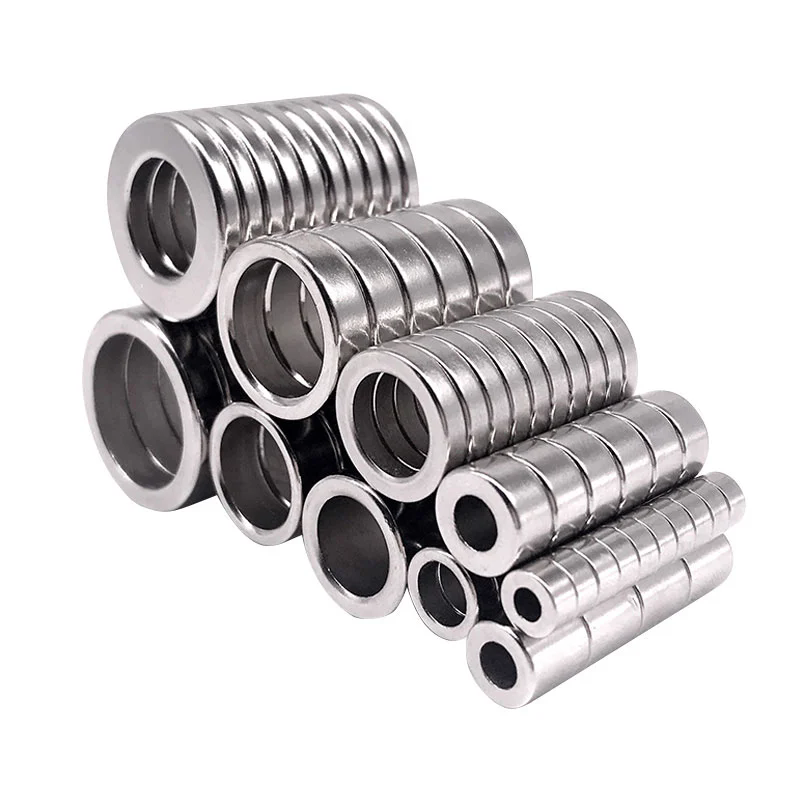
Table of Contents
- 1. How Are Ring Magnets Designed for Stable Magnetic Performance?
- 2. How Do Key Parameters Determine Ring Magnet Selection?
- 3. How Are Ring Magnets Applied Across Different Industries?
- 4. How Will Ring Magnets Evolve With Future Technologies?
- Ring Magnet FAQ
- References
- Contact Information
1. How Are Ring Magnets Designed for Stable Magnetic Performance?
Ring magnets, also referred to as annular magnets, are characterized by a circular outer diameter and a concentric inner hole. This geometry enables symmetrical magnetic flux distribution, making ring magnets especially suitable for rotating systems, axial assemblies, and applications requiring consistent magnetic force around a central axis.
The operating principle of a ring magnet is based on controlled magnetic domain alignment during magnetization. Depending on the application, ring magnets may be magnetized axially (north and south poles on flat surfaces) or radially (north on the inner diameter and south on the outer diameter, or vice versa). Each magnetization method directly affects torque output, field strength, and system efficiency.
Common material types include neodymium iron boron (NdFeB), ferrite (ceramic), samarium cobalt, and alnico. Among these, neodymium ring magnets are frequently selected for compact designs requiring high energy density, while ferrite ring magnets remain preferred for cost-sensitive or high-temperature environments.
2. How Do Key Parameters Determine Ring Magnet Selection?
Engineering-grade ring magnets are defined by a set of measurable parameters that directly influence performance, durability, and compatibility with system requirements. Accurate specification of these parameters is essential for ensuring reliable long-term operation.
| Parameter | Description | Engineering Significance |
|---|---|---|
| Outer Diameter (OD) | Total external diameter of the ring | Determines contact area and magnetic coverage |
| Inner Diameter (ID) | Diameter of the central hole | Allows shaft mounting or sensor integration |
| Thickness | Axial height of the magnet | Influences magnetic field depth and holding force |
| Magnetization Direction | Axial or radial | Affects torque output and flux path |
| Magnetic Grade | Material-specific energy level | Defines maximum operating performance |
| Coating | Surface protection layer | Improves corrosion resistance and durability |
Additional considerations include operating temperature range, coercivity, and environmental exposure. Proper parameter alignment ensures compatibility with motors, sensors, couplings, and electronic assemblies.
3. How Are Ring Magnets Applied Across Different Industries?
Ring magnets are integral components in a wide range of industries due to their versatility and predictable magnetic behavior.
Industrial Automation: Ring magnets are used in servo motors, encoders, and robotic joints, where precise rotational feedback and consistent torque are required.
Automotive Systems: Applications include electric power steering, ABS sensors, and brushless DC motors, where durability and vibration resistance are critical.
Medical Devices: Diagnostic and therapeutic equipment employ ring magnets in imaging systems, pumps, and motion-control assemblies due to their stability and compact form.
Consumer Electronics: Ring magnets support speakers, vibration motors, and wireless charging modules, enabling miniaturized designs without compromising performance.
4. How Will Ring Magnets Evolve With Future Technologies?
Future development of ring magnets is closely tied to advancements in material science and manufacturing precision. Higher energy density materials, improved thermal stability, and enhanced coating technologies are driving broader adoption in electric mobility, renewable energy systems, and smart manufacturing.
As system designs continue to shrink while performance expectations increase, ring magnets are expected to play a larger role in integrated assemblies requiring both mechanical and magnetic efficiency.
Ring Magnet FAQ
How does axial magnetization differ from radial magnetization in ring magnets?
Axial magnetization places magnetic poles on the flat faces of the ring, making it suitable for attraction and holding applications, while radial magnetization distributes poles along the inner and outer diameters, optimizing torque and rotational efficiency.
How is the correct ring magnet material selected?
Material selection depends on required magnetic strength, operating temperature, environmental exposure, and cost constraints. Neodymium is preferred for high strength, while ferrite is chosen for stability and economy.
How can ring magnets maintain performance over long service life?
Performance stability is ensured through proper grade selection, appropriate coatings, controlled operating temperatures, and correct mechanical integration to prevent demagnetization or physical damage.
References
- ISO 9001 Quality Management Systems
- ASTM International Magnetic Material Standards
- IEC Electromechanical Component Guidelines
Industry Collaboration and Contact
As a globally recognized manufacturer specializing in high-performance magnetic components, ZHAOBAO MAGNET GROUP provides engineered ring magnet solutions tailored to demanding industrial requirements. With advanced production capabilities and strict quality control, customized specifications can be supported for diverse applications.
For technical consultation, product specifications, or project-based collaboration, interested parties are encouraged to contact the ZHAOBAO MAGNET GROUP team to discuss application requirements and long-term supply solutions.