
How Does a Ring Magnet Differ from a Solid Magnet in Applications?
In the world of industrial magnetics, the choice between a Ring Magnet and a solid magnet is not merely a matter of shape. It is a decision that affects the magnetic field distribution, the mounting method, the assembly process, and ultimately the performance of the entire system. A solid magnet—whether a disc, block, or cylinder—presents a magnetic field that emanates from its entire surface. A Ring Magnet, by contrast, has a central hole that fundamentally alters the geometry of its magnetic field and opens up a range of design possibilities that are not available with solid magnets. Engineers who understand these differences can specify the right magnet for the application, whether it is a sensor, a motor, a magnetic coupling, or a holding device.
The question of how a Ring Magnet differs from a solid magnet in applications is best answered by examining the specific functional requirements of the application. A Ring Magnet is often used when the magnet must be mounted on a shaft, when the magnetic field must be concentrated in a specific annular region, or when the central hole is needed for assembly or alignment. A solid magnet is used when a strong, concentrated field is required at a single point, or when the magnet is part of a simple holding or clamping mechanism. This article will provide a comprehensive technical comparison of Ring Magnets and solid magnets, covering magnetic field geometry, mounting and assembly considerations, application-specific selection criteria, and the material and manufacturing factors that differentiate them.
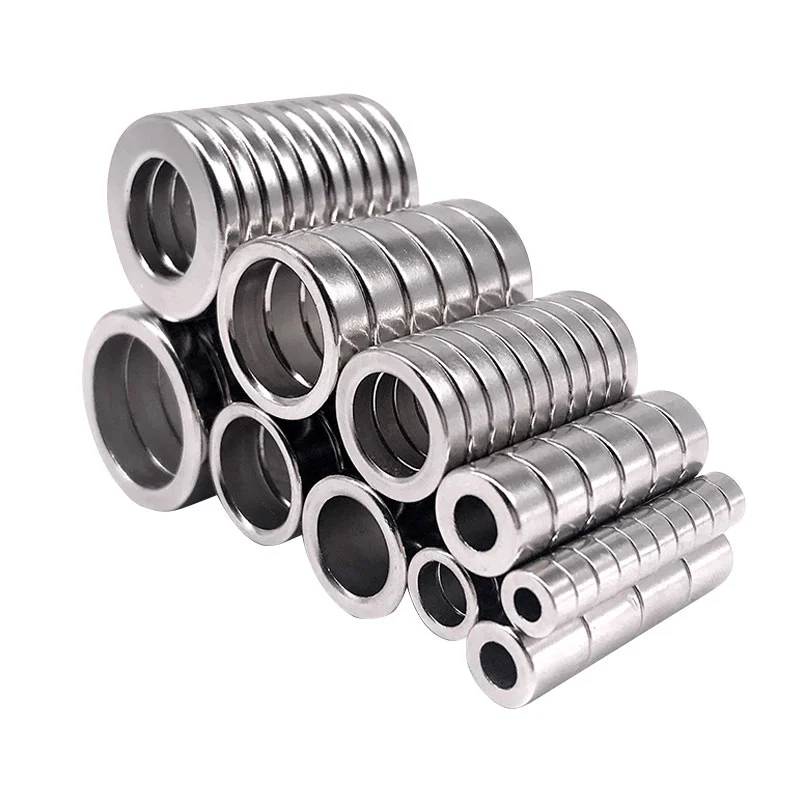
Table of Contents
- 1. What Is a Ring Magnet and How Is It Different from a Solid Magnet?
- 2. How Does the Magnetic Field Geometry Differ Between Ring and Solid Magnets?
- 3. Why Does Mounting and Assembly Favor Ring Magnets in Rotating Systems?
- 4. What Are the Key Application Differences Between Ring and Solid Magnets?
- 5. How Do Material Selection and Manufacturing Processes Compare?
- 6. Frequently Asked Questions (FAQ)
- 7. Conclusion
1. What Is a Ring Magnet and How Is It Different from a Solid Magnet?
A Ring Magnet is a permanent magnet with a central hole, creating an annular (ring-like) shape. The hole can be of various sizes, from a small bore to a large opening that approaches the outer diameter. The magnet can be axially magnetized (with the poles on the flat faces) or diametrically magnetized (with the poles on the curved surfaces). The choice of magnetization direction depends on the application. A solid magnet, by contrast, has no central hole. It is a solid piece of magnetic material, such as a disc, block, or cylinder. The distinction is simple in geometry but profound in function. The central hole of a Ring Magnet is not just a weight-saving feature; it is a functional element that enables the magnet to be mounted on a shaft, a tube, or a threaded rod. It also changes the distribution of the magnetic field, concentrating it in the annular region rather than throughout the entire volume.
To understand the difference, consider the basic physics of a permanent magnet. A solid disc magnet has a magnetic field that is strongest at its center and decays with distance. The field lines emerge from the north pole face and return to the south pole face. The field is generally symmetric about the central axis. A Ring Magnet has a similar overall field pattern, but the central hole creates a region of lower field strength in the middle. This can be advantageous in applications where the center of the magnet must be free of magnetic interference, such as when a sensor is placed in the center of the ring. The table below summarizes the basic differences between a Ring Magnet and a solid magnet.
| Feature | Ring Magnet | Solid Magnet |
| Geometry | Annular (with central hole) | Solid (no hole) |
| Mounting | Can be mounted on shafts, tubes, or rods | Requires external clamping or adhesive |
| Field Distribution | Concentrated in the annular region | Concentrated at the center and edges |
| Magnetization Options | Axial, diametrical, or multipole | Axial or diametrical (limited) |
| Weight | Lighter (less material) | Heavier (more material) |
| Typical Applications | Sensors, motors, couplings, loudspeakers | Holding, clamping, magnetic separators |
At Xiamen Zhaobao Magnet Co., Ltd., we manufacture both Ring Magnets and solid magnets in a wide range of materials and sizes. Our factory's engineering team can help you determine which type is best suited to your application. The choice is not always obvious; it requires a careful analysis of the magnetic field requirements, the mechanical constraints, and the assembly process. In the following sections, we will examine these factors in detail.
2. How Does the Magnetic Field Geometry Differ Between Ring and Solid Magnets?
The magnetic field geometry of a magnet is determined by its shape and magnetization direction. For a Ring Magnet, the central hole creates a unique field distribution that is different from that of a solid magnet. To visualize this difference, imagine the field lines as they emanate from the magnet. In a solid disc magnet, the field lines are concentrated at the center and spread out as they move away from the surface. The field is strongest at the center of the disc face. In a Ring Magnet, the field lines are concentrated in the annular region between the inner and outer diameters. The center of the ring has a relatively weak field. This difference is critical in applications where the magnet is used to actuate a sensor or to interact with a specific part of a system.
The magnetization direction is another key factor. A Ring Magnet can be magnetized in several ways. Axial magnetization means the poles are on the flat faces of the ring. This is the most common type and produces a field that is similar to that of a solid disc, but with a hole in the middle. Diametrical magnetization means the poles are on opposite sides of the ring's outer diameter. This produces a field that is oriented across the ring, which is useful in applications such as magnetic encoders and rotary sensors. Multipole magnetization means the ring has multiple north and south poles around its circumference. This is used in applications such as magnetic couplings and brushless DC motors. The table below summarizes the different magnetization options for Ring Magnets.
| Magnetization Type | Pole Locations | Field Shape | Typical Applications |
| Axial | Flat faces | Similar to a disc, with a central hole | Holding, clamping, sensors |
| Diametrical | Opposite sides of the outer diameter | Field oriented across the ring | Encoders, rotary sensors |
| Multipole | Multiple poles around the circumference | Alternating field around the ring | Motors, magnetic couplings |
The field geometry also affects the magnetic force that the magnet can exert. A solid magnet with the same outer diameter and thickness as a Ring Magnet will generally have a higher pull force because it has more magnetic material. However, the Ring Magnet's field is more concentrated in the annular region, which can be an advantage in applications where the force must be applied to a specific area. At Xiamen Zhaobao Magnet Co., Ltd., we use advanced magnetic simulation software to model the field distribution of our Ring Magnets and solid magnets. This allows us to optimize the design for each customer's specific application.
3. Why Does Mounting and Assembly Favor Ring Magnets in Rotating Systems?
One of the most significant practical differences between a Ring Magnet and a solid magnet is the ease of mounting and assembly. A Ring Magnet has a central hole that can be used to mount the magnet on a shaft, a tube, or a rod. This is a critical advantage in rotating systems, such as motors, generators, and magnetic couplings, where the magnet must be precisely centered on a rotating axis. A solid magnet cannot be mounted in this way; it would require a separate mounting bracket or adhesive, which can be less precise and less reliable. The central hole of a Ring Magnet also allows it to be stacked on a shaft with other components, such as bearings and spacers, simplifying the assembly process.
In a typical brushless DC motor, for example, the rotor consists of a shaft with a Ring Magnet mounted on it. The magnet is magnetized with multiple poles, and it interacts with the stator windings to produce torque. The central hole of the Ring Magnet allows it to be press-fitted onto the shaft with a precise interference fit, ensuring that the magnet is perfectly concentric with the shaft. This is essential for smooth, vibration-free operation. A solid magnet would require a separate hub or carrier to mount it on the shaft, adding cost and complexity to the assembly. The table below compares the mounting characteristics of Ring Magnets and solid magnets.
| Mounting Method | Ring Magnet | Solid Magnet |
| Shaft Mounting | Direct (press-fit, adhesive, or set screw) | Requires a separate hub or carrier |
| Centering | Excellent (central hole ensures concentricity) | Moderate (requires external alignment) |
| Stacking | Easy (can be stacked on a shaft) | Difficult (requires spacers) |
| Assembly Complexity | Low | High |
| Typical Rotating Applications | Motors, generators, encoders, couplings | Not typically used |
The ease of mounting also extends to the assembly of magnetic assemblies, such as magnetic couplings and magnetic gears. In these assemblies, multiple magnets are arranged in a specific pattern to achieve a desired magnetic interaction. Ring Magnets can be easily mounted on a common shaft or within a common housing, ensuring precise alignment and spacing. This is much more difficult to achieve with solid magnets, which would require custom fixtures and alignment procedures. At our factory, we have extensive experience in designing and manufacturing magnetic assemblies using Ring Magnets. We can provide complete assemblies that are ready to install, saving our customers time and effort.
4. What Are the Key Application Differences Between Ring and Solid Magnets?
The choice between a Ring Magnet and a solid magnet is ultimately driven by the specific requirements of the application. While both types of magnets can be used in a wide range of applications, there are certain applications where one type is clearly superior. Understanding these application differences is essential for making the right selection. The following table provides a summary of the key application differences between Ring Magnets and solid magnets.
| Application | Preferred Magnet Type | Reason |
| Sensors (Hall Effect, Encoders) | Ring Magnet | Central hole allows mounting on a shaft; multipole magnetization provides precise position feedback. |
| Motors and Generators | Ring Magnet | Direct shaft mounting; multipole magnetization for smooth torque generation. |
| Magnetic Couplings | Ring Magnet | Concentric mounting on shafts; multipole magnetization for torque transmission. |
| Loudspeakers | Ring Magnet | The central hole accommodates the voice coil and allows the magnet to be mounted on the speaker frame. |
| Holding and Clamping | Solid Magnet | Higher pull force per unit volume; simple flat surface for direct contact. |
| Magnetic Separators | Solid Magnet | Strong, concentrated field for capturing ferrous particles; simple mounting. |
| Magnetic Tools | Solid Magnet | Compact, high-strength field for holding tools and parts. |
The application differences are not always clear-cut. In some cases, a Ring Magnet can be used in an application that traditionally uses a solid magnet, and vice versa. For example, a Ring Magnet can be used for holding if a central hole is required for a screw or bolt. A solid magnet can be used in a sensor if the sensor is designed to detect the field at the center of the magnet. The decision should be based on a careful analysis of the magnetic field requirements, the mechanical constraints, and the cost. At Xiamen Zhaobao Magnet Co., Ltd., we work closely with our customers to understand their application requirements and to recommend the most suitable magnet type. Our engineering team can provide magnetic simulation and prototyping services to validate the design before production.
5. How Do Material Selection and Manufacturing Processes Compare?
Both Ring Magnets and solid magnets can be manufactured from a wide range of magnetic materials, including neodymium (NdFeB), samarium cobalt (SmCo), and ferrite. The choice of material depends on the required magnetic strength, the operating temperature, and the cost. Neodymium is the strongest and most commonly used material for high-performance applications, but it has a lower operating temperature limit than samarium cobalt. Ferrite is weaker but much cheaper and has excellent corrosion resistance. The table below compares the key properties of these materials.
| Material | Magnetic Strength (BHmax) | Max Operating Temperature | Corrosion Resistance | Relative Cost |
| Neodymium (NdFeB) | 35 - 52 MGOe | 80 - 150°C | Poor (requires coating) | Medium |
| Samarium Cobalt (SmCo) | 16 - 32 MGOe | 250 - 350°C | Good | High |
| Ferrite | 3 - 5 MGOe | 250°C | Excellent | Low |
The manufacturing process for a Ring Magnet is more complex than for a solid magnet, particularly for diametrically or multipole magnetized rings. The ring must be pressed or machined to the correct dimensions, and the magnetization must be applied with precision to achieve the desired pole pattern. For multipole magnetization, a specialized magnetizing fixture is required, which can be expensive to design and manufacture. The inspection of Ring Magnets also requires specialized equipment, such as a Helmholtz coil or a magnetic field mapper, to verify the pole pattern and field strength. At our factory, we have invested in advanced magnetizing and inspection equipment to ensure that our Ring Magnets meet the most demanding specifications. We also offer a range of coatings, including nickel, zinc, epoxy, and Parylene, to protect the magnets from corrosion. Our commitment to quality and precision has made us a trusted supplier of Ring Magnets for customers around the world.
6. Frequently Asked Questions (FAQ)
Question 1: Can a Ring Magnet be used in place of a solid magnet in a holding application?
Answer: In some cases, yes. A Ring Magnet can be used for holding if the central hole is needed for a screw, bolt, or other fastening method. However, a solid magnet will generally provide a higher pull force for the same outer diameter and thickness because it has more magnetic material. If the holding force is critical and there is no need for a central hole, a solid magnet is usually the better choice.
Question 2: What is the advantage of a multipole Ring Magnet over an axially magnetized Ring Magnet?
Answer: A multipole Ring Magnet has multiple north and south poles around its circumference, while an axially magnetized Ring Magnet has poles only on its flat faces. The multipole configuration is used in applications that require a rapidly alternating magnetic field, such as brushless DC motors, magnetic encoders, and magnetic couplings. It allows for smoother torque generation and more precise position feedback.
Question 3: How do I choose the right magnetization direction for my Ring Magnet?
Answer: The choice of magnetization direction depends on the application. Axial magnetization is used when the magnetic field must be directed along the axis of the ring, such as in a holding application or a simple sensor. Diametrical magnetization is used when the field must be directed across the ring, such as in a rotary encoder. Multipole magnetization is used when a rapidly alternating field is required, such as in a motor or a magnetic coupling. Our technical team can help you select the optimal magnetization direction for your application.
Question 4: What is the maximum operating temperature for a neodymium Ring Magnet?
Answer: The maximum operating temperature for a neodymium Ring Magnet depends on the grade of the material. Standard grades have a maximum operating temperature of 80°C. High-temperature grades can operate at up to 150°C or even 200°C, but these grades have a lower magnetic strength. For applications that require both high temperature and high magnetic strength, samarium cobalt is the preferred material.
Question 5: Can Ring Magnets be customized for specific dimensions and tolerances?
Answer: Yes, Ring Magnets can be customized for specific dimensions and tolerances. At Xiamen Zhaobao Magnet Co., Ltd., we offer custom manufacturing services for Ring Magnets in a wide range of sizes and shapes. We can machine the magnets to precise tolerances, apply custom coatings, and magnetize them to your exact specifications. Our engineering team can work with you to design the perfect Ring Magnet for your application.
7. Conclusion
The difference between a Ring Magnet and a solid magnet is more than just the presence of a hole. It is a fundamental difference in magnetic field geometry, mounting capability, and application suitability. A Ring Magnet is the preferred choice when the magnet must be mounted on a shaft, when the field must be concentrated in an annular region, or when a multipole field is required. A solid magnet is preferred when a high, concentrated pull force is needed, or when the magnet must be part of a simple holding or clamping mechanism. Understanding these differences is essential for engineers and designers who specify magnets for their products. At Xiamen Zhaobao Magnet Co., Ltd., we have the expertise and the manufacturing capabilities to produce both Ring Magnets and solid magnets to the highest standards. Our factory uses advanced materials, precision manufacturing processes, and rigorous quality control to ensure that every magnet we produce meets the requirements of our customers.
If you are unsure which type of magnet is best for your application, our technical team is here to help. We offer free consultation and design support to help you select the optimal magnet for your needs. Contact us today to discuss your application and to request a quote.
Contact Xiamen Zhaobao Magnet Co., Ltd. today to discuss your Ring Magnet or solid magnet requirements and discover how our magnetic solutions can improve your products.